
Tradition versus technology, AI versus craftsmanship.
- Hannah Siwula
- 11 jan
- 6 minuten om te lezen

When I was looking for an internship as a first-year goldsmith, I hit a wall I'd been warned about: the closed-mindedness within the Goldsmith's Guild.
I was a student at the (at the time)only goldsmithing school in the Netherlands, looking for a trial internship, I was rejected everywhere. Why? I was told to return during my final year so that I could at least contribute something. No one was enthusiastic about passing on knowledge and teaching the trade to the next generation.
Finally, I was enthusiastically welcomed at the repair workshop of Lucardi jewelers in Almelo, among others. There I saw my future would practically look like a factory worker, altering and repairing mostly inexpensive jewelry, so the repairs could only take minutes. Absolutely not the image I had in mind; quite the opposite, in fact.
The typical goldsmith
In 2025, I briefly apprenticed again, this time with a Master Goldsmith in Utrecht (not the goldsmith on the image) who explicitly stated his willingness to share his knowledge. Unfortunately, the reality turned out to be different, and he, too, wasn't open to his students' own insights or fresh ideas.
He was very straightforward: my way or the highway. After being told, for the countless time, that while my idea was possible, we weren't going to pursue it, I decided to choose my own path.

Unfortunately, these kinds of stories are absolutely not uncommon. The typical image of a goldsmith is often a somewhat older, grumpy man with permanently dirty fingernails, fused to the loupe on his head, sitting behind his scythe.

The fresh image brought by the beautiful Instagram girls with perfectly manicured hands doesn't change much. I'll never belong to the latter category myself, because that's simply not the reality of the goldsmith's trade. Your hands get dirty, your nails get damaged, and this only adds to the true beauty of working with metals, chemicals, and polishing grease.
New technology versus old traditions
While I truly appreciate that the craft of goldsmithing has existed for thousands of years, I'm actually curious about all the new technologies and innovations that have developed. Especially since my school days in the early 2000s, and that's a lot, a whole lot!
What strikes me, especially on social media, is the heated debate that ensues whenever tools are presented that (supposedly) make a goldsmith's work easier.
Discussions that, often mixed with ego and pride, see new technology as a threat to the goldsmith's craft. But is that really the case?
Synthetic: fake imitation or affordable alternative?
A good example is synthetic diamonds. Little knowledge is shared about this technology, which already hit the market in 1950. Why? It's very simple: diamonds are sold as unique objects that are not only rare, but also incredibly expensive and a status symbol.
But if you compare a rose grown in an open field with one grown in a greenhouse, you arrive at two conclusions: they are both roses, and the only difference is the time it takes for the flower to grow.
Even the issue of scarcity can't be brought up when discussing diamonds. It's misleading marketed by the De Beers family, who, with their former monopoly on the diamond industry, led us to believe that diamonds are only for the wealthy elite.
Diamonds consist purely of carbon, the 15th most abundant element in the Earth's crust, and it's estimated that the Earth currently contains 1 billion tons of diamonds. Although only a small portion of these are suitable for jewelry and an even smaller number contain truly special diamonds of larger dimensions, this is still an astronomical number.
Mining versus growing

Highlighting the horrors of diamond mining and the bloody and often corrupt history of diamonds is often dismissed as a thing of the past. However, it's still difficult to this day to find a diamond where both its ecological and social impacts have been fully controlled and managed. Unfortunately, diamonds aren't found on the surface, and mining them requires moving an unimaginable amount of dirt, with a significant ecological impact on nature and all its habitants.
And that's not even mentioning the number of diamonds that have been in circulation for years in antique and vintage jewelry worn daily, without clear knowledge of their origin.

Monitoring working conditions and environmental impact in a laboratory is much easier than in a privately operated mine somewhere in Africa. There are also laboratories that grow their diamonds using green energy and, instead of a large carbon footprint, actually produce more energy than they use. However, many laboratories are emerging where working conditions and environmental impact are also being debated, so thorough research and critical thinking are crucial before entering into a relationship with a supplier.
The stigmas, taboos and misinformation
Are lab-grown diamonds really the future? Given current vision, I think there's still too much stigma attached to the use of lab-created stones. "But a real diamond is much more beautiful!" Only if you're looking for a stone with many inclusions, which usually makes a natural diamond less desirable.

A lab-grown diamond is still a diamond, not a cubic zirconia, contains no inclusions, and can only be distinguished from a natural diamond with specialized equipment. The rules regarding grading are the same for all diamonds; the certificate simply states whether the origin is natural or laboratory-grown. The biggest difference lies in the price, which is significantly lower for lab-grown diamonds.

But there are many more innovations where I see real improvements, such as designing jewelry in CAD and then printing it out using a 3D printer. This method significantly reduces precious metal loss, and the design possibilities are endless. Unfortunately, this method also faces considerable opposition, with the main message being that a piece of jewelry can no longer be called "handmade," but rather "hand assembled."

The art of casting jewelry is indeed very old and accepted in the goldsmithing world, but the lost wax method (where the artist first manually carves a piece of jewelry from jewelers' wax) encounters much less resistance than a mold of a 3D printed object that is then filled with molten precious metal.
Where is the opportunity for savings?
In times where precious materials are becoming increasingly scarce and expensive, we're experiencing record gold and silver prices. Therefore, I will no longer be working with 14 or 18 karat gold, as this doesn't financially align with what price ranges I want to offer.
Alternatives like gold plated and gold filled just don't guarantee the durability and quality I support, not to mention the risk of allergic reactions.
Instead I consider using materials like high-quality silver or 9 karat, which has been on the market for a long time as a very affordable alternative to gold. While it may not be allowed to be called gold in the Netherlands, it has the visual properties and shine of gold, with a hardness and scratch resistance that are superior to silver.
I will always continue to seek improvements, time savings, and cost reductions within ethical guidelines. Outsourcing parts of the process to people who are paid less for the same work simply isn't on my list of options.
The influence of AI
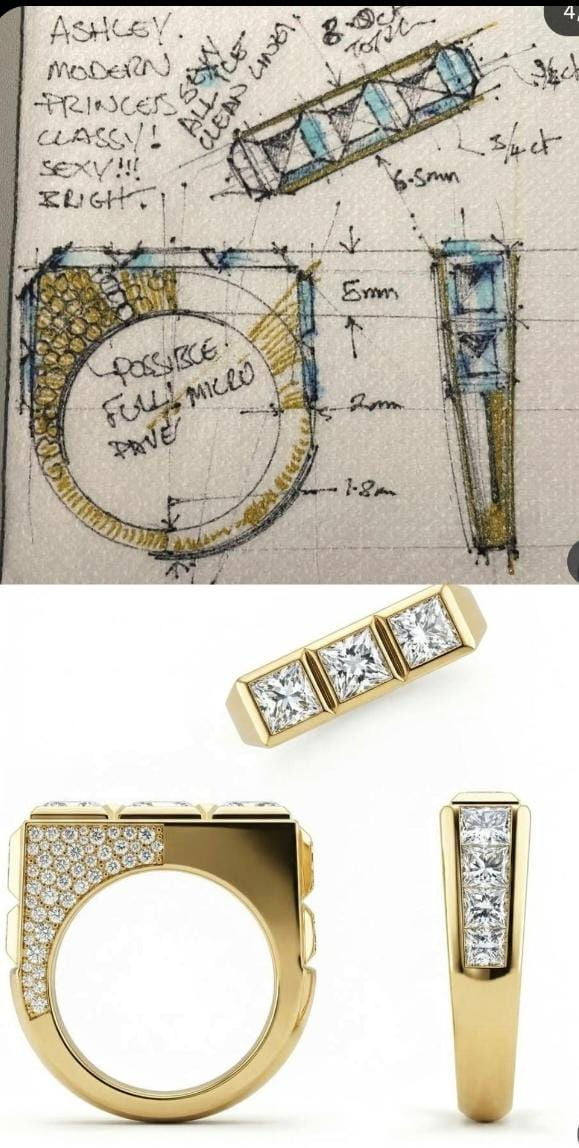
Let's address one more elephant in the room: Artificial Intelligence.
Personally, I'm not a fan of AI because I think we'll become too dependent on software that is designed to shows us exactly what we're looking for. However, today I encountered software that specializes in converting drawings into 3D-printable models of the drawn piece of jewelry, complete with a cost calculation. This certainly saves a tremendous amount of time, but given my caution with AI, I'm very curious to hear your thoughts.
So what’s next?
This summer, I'll be specializing in traditional techniques for a month at a school in Kraków, Poland. Despite my welcoming vision of technology, this is nothing without mastering the basics, and the lessons at the school were over 15 years ago. I also want to be able to create jewelry from scratch for clients who do value craftsmanship without digital intervention.
In the meantime, I'll continue to develop my skills in drawing and designing jewelry, both on paper and digitally. I'll also be seeking out suppliers of ethical materials and both natural and synthetic stones to build a reliable supplier base to guarantee the highest quality.
A journey I'll naturally take you on, to celebrate the successes together and, above all, to laugh when things go hilariously wrong.